Nephilim, Demons, and the Early Church:

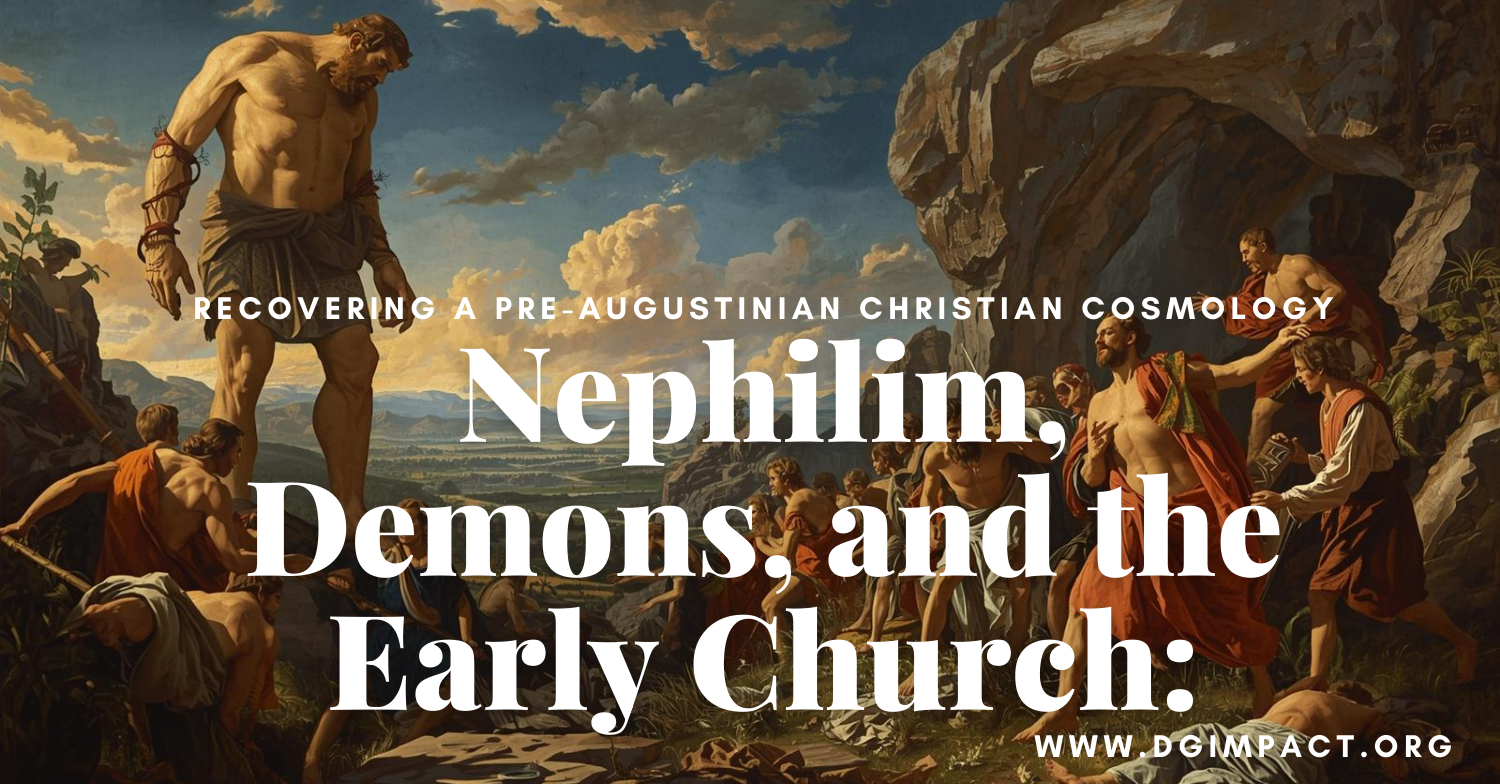
Nephilim, Demons, and the Early Church:
Recovering a Pre-Augustinian Christian Cosmology
Introduction: A Forgotten Assumption
Modern Christian theology often assumes that demons are simply fallen angels. This idea is taught casually, preached confidently, and rarely questioned. Yet this framework is not the one inherited by the earliest Christians. Instead, the first centuries of the Church preserved a far older cosmology—one rooted in Second Temple Judaism, reflected in texts like 1 Enoch, and assumed by multiple early Church Fathers.
I find myself caught between the two views. I lean more toward the perspective grounded in Scripture and the ancient writings, especially in light of having personally witnessed the Holy Spirit (not myself) drive out many of the demons we are discussing here. At the same time, I believe it is possible that there are multiple kinds—or natures—of spiritual beings that the Lord’s Church encounters and contends with. But certainly as in gangs, their are usally a chief or leader what the scripture speaks of being an "strongman".
In this earlier worldview, fallen angels (or Watchers) were not identical with demons. Rather, demons were understood as the disembodied spirits of the Nephilim, the hybrid offspring of rebellious angels and human women described in Genesis 6. These spirits, denied rest and embodiment, were believed to roam the earth afflicting humanity.
This essay traces that understanding through the early Church, shows how it functioned coherently in Christian theology, and explains how Augustine’s later synthesis unintentionally replaced it, reshaping Western Christian demonology.
I. Jewish Roots: The Watchers and the Nephilim
Before Christianity existed, Second Temple Judaism already had a developed supernatural worldview. Genesis 6:1–4 was not read symbolically or sociologically, but cosmologically.
1 Enoch (3rd–1st century BCE), widely read and respected among Jews and early Christians, expands Genesis 6 into a detailed narrative:
-
Angels called Watchers descend to earth
-
They take human wives
-
Their offspring are giants (Nephilim)
-
These giants devastate the earth
-
When destroyed, their spirits remain, condemned to wander
“The spirits of the giants… shall be called evil spirits upon the earth… because they are born from men and from the holy Watchers is their beginning.”
(1 Enoch 15:8–9)
Crucially, these spirits are not angels. They are something new, unnatural, and cursed—bodiless beings craving material existence.
This background was not fringe. It was assumed.
II. The Apostolic Worldview: Implied, Not Explained
The New Testament never pauses to explain where demons come from — because its audience already knew.
Consider what demons do in the Gospels:
-
They seek bodies
-
They fear being sent to the Abyss
-
They cause illness, madness, and compulsion
-
They operate locally, not cosmically
Meanwhile, Satan is portrayed as:
-
A ruler
-
A tempter
-
One with authority and dominion
These are not the same category of being.
Jesus never calls demons “angels.” Nor do demons claim heavenly rank. The distinction is assumed, not argued.
III. The Second Century: Church Fathers Speak Plainly
Justin Martyr (c. 100–165 AD)
Justin is one of the clearest witnesses to early Christian cosmology. Writing within living memory of the apostles’ generation, he explicitly connects demons to angelic-human unions.
“The angels transgressed… and begat children who are called demons.”
(Second Apology, ch. 5)
For Justin:
-
Angels fall through lust
-
Their offspring corrupt humanity
-
After death, these offspring become demons
He does not equate demons with fallen angels. He distinguishes cause from consequence.
Athenagoras of Athens (c. 133–190 AD)
Athenagoras is remarkably precise. He describes a tiered supernatural hierarchy:
“Some angels fell… and of the giants begotten by them were the demons who haunt the world.”
(Plea for the Christians, ch. 24)
Here we see:
-
Fallen angels = original transgressors
-
Giants = physical hybrids
-
Demons = post-mortem spirits of giants
This is textbook Enochian theology — now fully Christianized.
IV. Irenaeus: Heresy, Knowledge, and the Giants
Irenaeus of Lyons (c. 130–202 AD)
Irenaeus links angelic rebellion, forbidden knowledge, and demonic oppression.
“Angels transgressed and brought down forbidden arts… and from their union with women came a race of giants.”
(Against Heresies, Book IV)
Though less explicit about demon ontology, Irenaeus treats demons as derivative beings, not cosmic rulers. They are corrupters, not authorities.
This fits perfectly with the Nephilim model: demons harass; powers rule.
V. Tertullian: Defender of Enoch
Tertullian (c. 155–220 AD)
Tertullian goes further than most — he defends the Book of Enoch itself.
“I am aware that the Scripture of Enoch is not accepted by some… but since it is quoted by Jude, it cannot be rejected.”
(On the Apparel of Women, ch. 3)
He then explains demonic behavior:
“These are the spirits of the giants… who wander without rest, craving bodies.”
(paraphrased from On the Soul)
For Tertullian:
-
Demons are restless because they were never meant to exist without flesh
-
Possession is not metaphorical — it is existential hunger
This is not speculative theology. It is pastoral explanation.
VI. Lactantius and the Early Fourth Century
Lactantius (c. 250–325 AD)
Writing on the eve of Constantine, Lactantius still preserves the older framework:
“The demons are the spirits of the dead giants… who seek to draw men into error.”
(Divine Institutes, Book II)
Even at this late stage:
-
Fallen angels are distinct
-
Demons are earthbound
-
The hierarchy remains intact
The shift has not yet happened.
VII. Timeline Summary: Before Augustine
3rd–1st c. BCE
• 1 Enoch codifies the Watchers → Nephilim → demons framework
1st c. AD
• New Testament assumes demon behavior consistent with bodiless spirits
2nd c. AD
• Justin Martyr, Athenagoras affirm giants → demons
• No father equates demons with fallen angels
3rd c. AD
• Tertullian defends Enoch
• Lactantius preserves the distinction
Up to this point, the theology is remarkably consistent.
VIII. Augustine: A Different Project
Augustine of Hippo (354–430 AD)
Augustine did not set out to erase earlier theology. His goals were different:
-
Integrate Christianity with Neoplatonism
-
Eliminate mythic ambiguity
-
Create a stable metaphysical system
He rejected:
-
Angelic corporeality
-
Hybrid beings
-
Enochic cosmology
As a result, he collapsed categories.
“Demons are nothing else than fallen angels.”
(City of God, Book IX)
This was not apostolic inheritance — it was philosophical simplification.
IX. What Was Lost
By merging fallen angels and demons, Augustine unintentionally erased:
-
The reason demons seek bodies
-
The distinction between rulers and parasites
-
The explanatory power behind possession narratives
-
The Second Temple Jewish context of Scripture
Western Christianity gained clarity — but lost coherence.
X. Eastern Christianity and Lingering Traces
Notably, the Eastern Church never fully adopted Augustine’s demonology.
-
Patristic liturgies still distinguish spirits
-
Exorcism language assumes embodiment hunger
-
Cosmic hierarchies remain more fluid
The older worldview never entirely disappeared — it was simply overshadowed in the Latin West.
Conclusion: Recovery, Not Innovation
The claim that demons are the spirits of the Nephilim is not modern, fringe, or conspiratorial. It is patristic, Jewish, and ancient.
Augustine did not invent error deliberately — but his synthesis overrode an older, widely held Christian cosmology. Recovering that worldview is not rebellion against tradition. It is fidelity to the Church’s earliest memory.
The question is not whether the early fathers believed this.
They clearly did.
The question is whether we are willing to listen to them again.